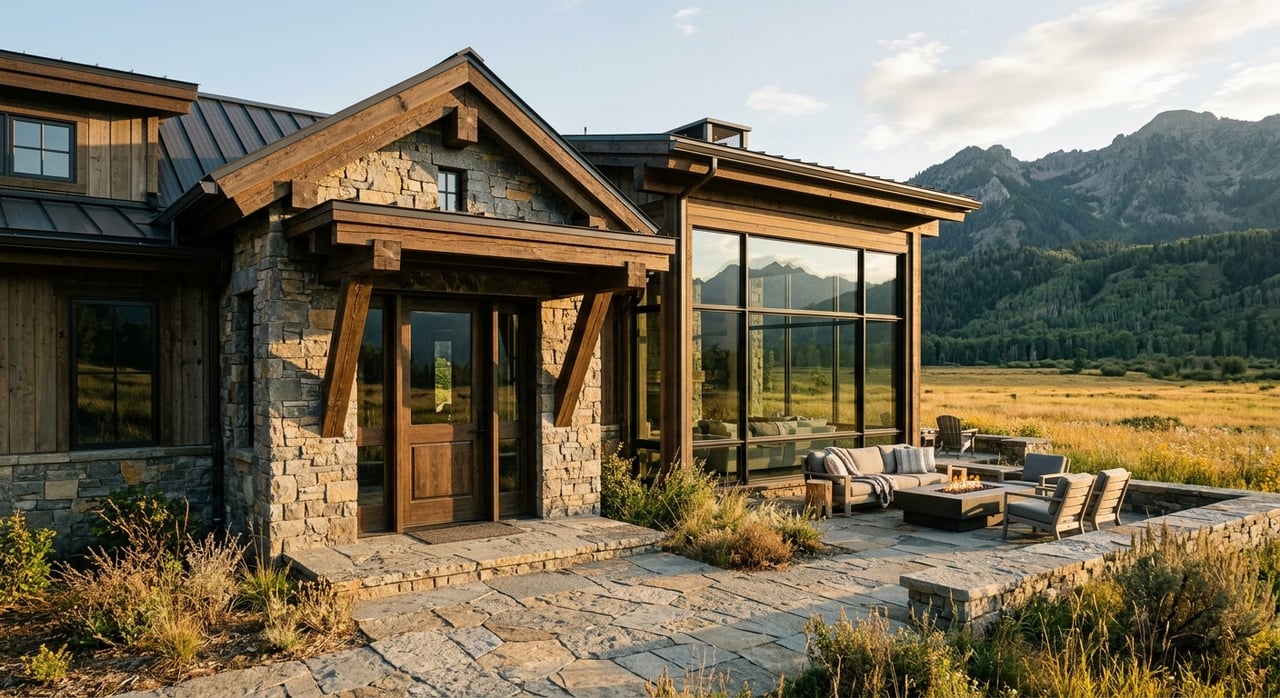
What to Know Before Building on the Telluride Mesas
July 2, 2026
July 2, 2026
Eric Saunders | Telluride Real Estate Advisor
An essential guide to land due diligence, San Miguel County permitting, OWTS septic requirements, driveway engineering, and Colorado WUI wildfire codes across the Telluride mesas.
Custom Home Building on Telluride Mesas: 2026 Quick-Take Summary
Development Vector | Regulatory / Engineering Rule | Primary Buyer Impact |
|---|---|---|
Driveway Engineering | Engineer stamp required if driveway >500 ft or grade >6.0% | Requires civil engineering review and drainage plan submittals |
Utility & Septic (OWTS) | San Miguel County OWTS permit; CO DWR well review up to 49 days | Requires early soil percolation testing and well permit filing |
Wildfire Resiliency Code | Colorado WUI Code enforced starting July 1, 2026 | Mandates ignition-resistant materials and defensible space zones |
Building a custom home on the Telluride mesas requires navigating San Miguel County land use regulations, OWTS septic permits, and driveway engineering rules [1]. Yes, mesa projects offer expansive acreage and mountain views, though buyers must complete land diligence, secure well permits (up to 49 days), and comply with Colorado Wildfire Resiliency Code standards [1].
Eric Saunders provides experienced advisory for land buyers evaluating parcel feasibility, HOA design guidelines, and entitlement pathways across San Miguel County.
Compare parcel sizes, HOA design caps, and utility infrastructure requirements across prime Telluride mesa communities [1]:
Mesa Community | Typical Parcel Scale | HOA Architectural Caps | Utility & Infrastructure Baseline |
|---|---|---|---|
Aldasoro Ranch | 1.0 to 15.0 Acres (160 sites / 1,515 acres) | 25-ft or 35-ft max visible height cap; low-profile massing | Central water system, underground utilities, OWTS septic |
Deep Creek Mesa | 3.0 to 10.0 Acres | Subdivision-specific design review rules | Individual water wells, private OWTS septic, county road access |
Gray Head | 35.0-Acre Private Parcels (8 miles to town) | Strict HOA design review & envelope restrictions | Private well water, individual OWTS septic, shared trail systems |
West Meadows | 35.0-Acre Equestrian Lots | Design guidelines protecting peak view corridors | Private water wells, OWTS septic, private road maintenance |
Wilson Mesa & Sun Ridge | 10.0 to 35.0+ Acre Ranch Tracts | San Miguel County Land Use Code baseline | Off-grid or long utility extension, well drilling, private OWTS |
Note: Land use parameters derive from San Miguel County Planning Department records and community HOA covenants [1].
Dreaming about a custom home on the Telluride mesas is easy [1]. Turning that vision into a buildable plan is where the real work begins [1]. If you want privacy, expansive views, and room to create something lasting near town, understanding how land due diligence, road access, water rights, wastewater systems, and design review boards shape the outcome from day one is essential [1].
The mesas surrounding Telluride offer a fundamentally different ownership experience than in-town properties [1]. Homeowners secure larger acreage, greater physical separation, and a secluded mountain setting while remaining connected to the amenities of Telluride and Mountain Village [1].
However, mesa living is not uniform [1]. Some parcels sit within established master-planned communities with shared central water systems and strict architectural oversight, while others offer a rural framework with fewer built-in services [1].
A crucial first step is resetting expectations around parcel size across San Miguel County mesas [1]:
A common mistake among land buyers is developing house concepts prior to confirming site constraints [1]. On the mesas, site conditions dictate building design [1]. Before starting architectural plans, verify whether the parcel lies in unincorporated San Miguel County or a specific municipality [1].
In unincorporated San Miguel County, setbacks are zone-district specific under Article 5 of the Land Use Code [1]. Because county GIS mapping is not survey-accurate, hiring a licensed surveyor for an official boundary survey and topographic map is mandatory [1].
Mesa driveway access directly impacts building placement, site engineering budgets, and emergency vehicle accessibility [1]. San Miguel County requires a detailed site plan showing road access, curve radii, turnarounds, and positive drainage [1].
Water and wastewater infrastructure sit on the critical path for mesa construction [1]. San Miguel County administers Onsite Wastewater Treatment System (OWTS) permits for systems under 2,000 gallons per day [1].
For water supply, the Colorado Division of Water Resources (DWR) evaluates well permit applications [1]. Complete well permit applications require up to 49 days for state review [1]. Completing soil percolation testing and well permit filings early prevents pre-construction delays [1].
Community design standards heavily influence architectural form on mesa properties [1]. For example, Aldasoro Ranch design rules mandate low-profile horizontal massing that blends with the natural landscape [1]. Aldasoro enforces building-site boundaries and specific height caps, including a 25-foot absolute height limit on designated height-restriction lots and a 35-foot maximum visible height on standard lots [1]. Communities like Gray Head also route design reviews through an architectural committee to preserve neighborhood visual continuity [1].
San Miguel County adopted the Colorado Wildfire Resiliency Code on April 1, 2026, with mandatory enforcement beginning July 1, 2026 [1]. The Wildland-Urban Interface (WUI) code requires ignition-resistant exterior materials, defensible space clearing around structures, and emergency vehicle turnaround standards for mesa builds [1].
In addition to vertical construction costs, mesa land development requires budgeting for entitlement and soft costs [1]. San Miguel County planning review fees scale with project valuation [1]. Furthermore, new non-deed-restricted single-family residences of 2,000 square feet or larger are subject to the county's Employee Housing Impact Mitigation Fee [1]. Additional soft costs include land surveys, geotechnical engineering, septic design, well drilling, and driveway grading [1].
Following a structured sequence prevents costly design revisions [1]:
San Miguel County requires construction to commence within one year of development permit issuance [1].
Eric Saunders is a licensed broker providing expert land advisory across San Miguel and Ouray counties [1]. Assisting buyers with parcel selection, HOA design rules, and county entitlement steps in Aldasoro Ranch, Deep Creek Mesa, and Gray Head, Eric delivers reliable guidance for custom builds [1].
Contact Eric Saunders | Telluride Real Estate Broker
Generic search portals like Zillow and LandWatch treat mesa parcels as raw acreage, failing to reflect critical development realities [1]. Online platforms do not display building envelope boundaries, OWTS soil percolation results, CO DWR well permit status, or HOA height restrictions [1]. Furthermore, algorithms fail to calculate driveway engineering costs for steep lots or employee housing mitigation fees [1]. Working with an experienced local land broker like Eric Saunders ensures you evaluate parcels based on complete engineering and legal facts [1].
Discover adjacent local market analysis, submarket breakdowns, and regional lifestyle guides:
Whether you are seeking a 3-acre lot in Aldasoro Ranch or 35 acres in Gray Head or West Meadows, partner with Eric Saunders for expert land acquisition advisory.
Lot sizes vary widely by community. Aldasoro Ranch ranges from 1 to 15 acres, while Gray Head and West Meadows offer 35-acre private parcels [1].
San Miguel County requires a certified professional engineer stamp for driveways longer than 500 feet or steeper than 6.0% grade, including emergency vehicle turnarounds [1].
The Colorado Division of Water Resources (DWR) requires up to 49 days to complete evaluations for well permit applications [1].
Enforced starting July 1, 2026, the Wildland-Urban Interface code requires ignition-resistant building materials and defensible space clearing around structures [1].
Budget for boundary surveys, OWTS septic design, well drilling, driveway engineering, San Miguel County planning fees, and the Employee Housing Impact Mitigation Fee [1].
San Miguel County stipulates that construction must commence within one year of development permit issuance [1].
Source: San Miguel County Land Use Code & Building Dept [1]; Colorado Division of Water Resources (DWR); Aldasoro Ranch HOA Covenants.
August 20, 2026
Areas
Eric Saunders | August 14, 2026

Areas
Eric Saunders | August 14, 2026
Areas
Eric Saunders | August 14, 2026
Areas
Eric Saunders | August 14, 2026
Local Knowledge & Lifestyle
Eric Saunders | August 14, 2026
Local Knowledge & Lifestyle
Eric Saunders | August 14, 2026
Buying
Eric Saunders | August 14, 2026
Local Knowledge & Lifestyle
Eric Saunders | August 14, 2026
Eric loves to help people discover the mountain lifestyle and magic of Telluride. He brings a high level of professionalism and integrity to each transaction; allowing you to relax and enjoy the buying/selling process. He has been involved in over $400 million in real estate transactions and has guided clients through large-scale and single-family developments, condo, commercial and land purchases.