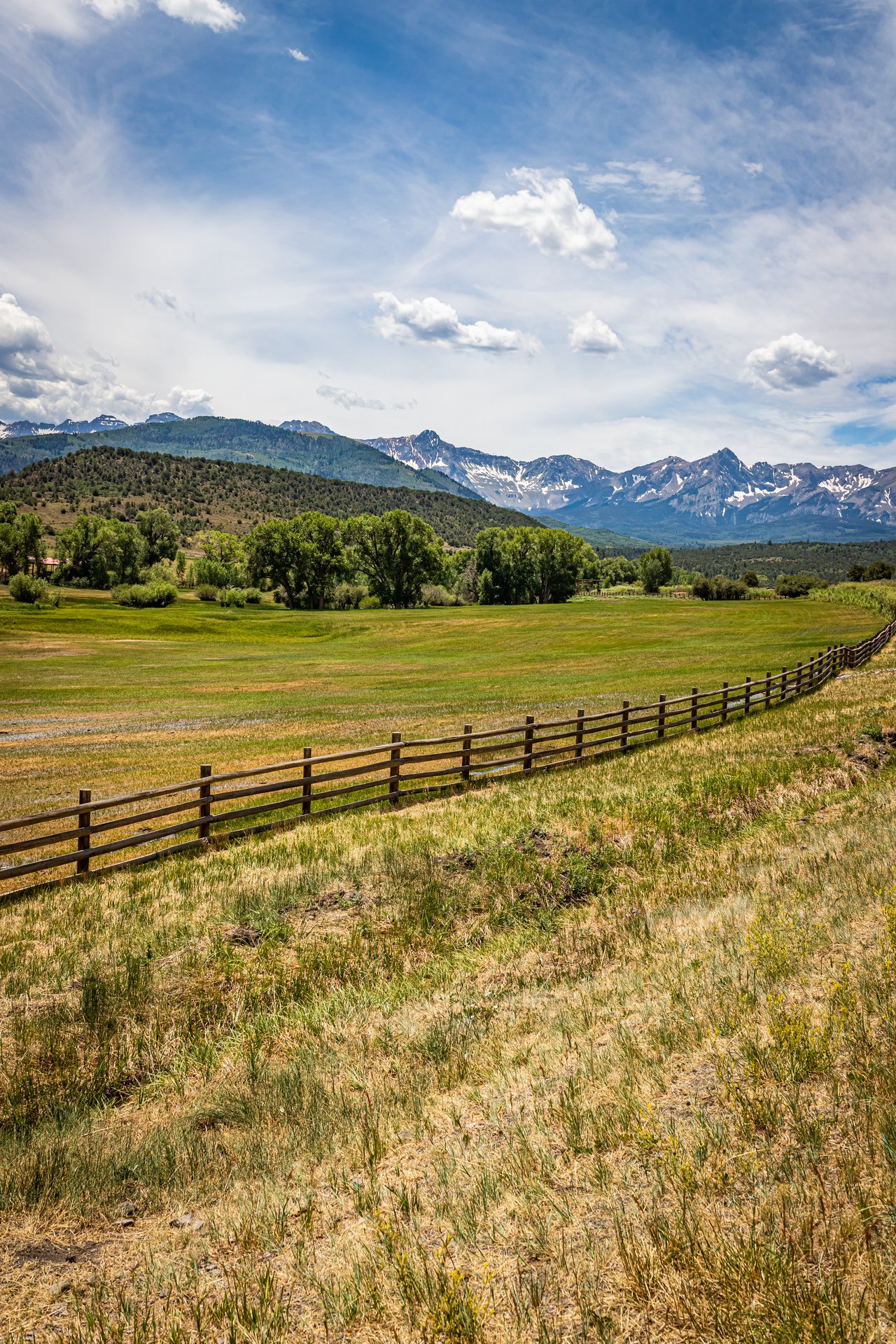
While Telluride is famous for its vertical drop, the real secret is the summer lifestyle. For relocation buyers in 2026, the draw is the year-round connectivity—hiking from your back door in the Mountain Village or walking to the farmer's market in the Historic Town.
Telluride offers a unique blend of cosmopolitan culture and rugged seclusion. It is one of the few places in the Rockies where you can attend a world-premiere film festival one day and disappear into the Uncompahgre Wilderness the next.
No Lift Lines & 2,000+ Skiable Acres
Bluegrass, Film Fest & Alpine Hiking
Telluride offers one of the most exciting and sustainable real estate investment opportunities in the U.S. With its unique combination of unmatched natural beauty, high-end tourism, exclusivity, and upcoming developments, the region is primed for significant long-term growth. This opportunity is akin to investing in Aspen, Vail, or Jackson Hole 10-15 years ago.
The combination of limited development, high demand and entitled projects has significant implications, particularly in terms of real estate and the future appreciation in the market. Telluride is an “island in the mountains” surrounded by public land, conversation easements and long-established PUD’s, all combining to land lock Telluride in a limited growth market.
Limited development means a constrained supply of housing and land, while high demand (driven by Telluride’s natural beauty, recreational opportunities, and exclusivity) drives property values up. The scarcity of available properties and significant down zoning over the last 4 decades, makes the market highly competitive and exclusive. Limited development also helps maintain Telluride’s unique, small-town feel rather than turning it into a sprawling resort area. Telluride is one of the “special” locations and is still being discovered.
There are some significant projects that are entitled and moving forward, further limiting future development. Specifically, there are 4 projects; (Fours Seasons Telluride, Six Senses Telluride, The Highline and Belvedere III) all entitled and these represent the last multi-unit development sites left in the Mountain Village Core.
The Telluride real estate market has a storied history dating back to its origins in the late 1800s as a mining town. As the mining-driven real estate era waned in the early 1900s, the mid 1900s were very quiet. Then, as World War I soldiers returned from the war, they returned to Colorado to finish what they started – Ski Areas.
While many other areas such as Aspen and Sun Valley had an earlier start as developing ski areas and towns in the early 1950s, Telluride did not get “discovered” as a ski town until Joe Zoline – a real estate developer from Aspen – opened the ski area in 1972. The next big event was the sale of the resort to Ron Allred and Jim Wells in 1978. They would make the most significant impact on the town and resort in the 1990s through extensive ski lift and golf course development, paving the way for Telluride to come to maturity in the 2000s.
This lagging timeline, in relation to other ski towns, has allowed Telluride to evolve more slowly and thoughtfully than essentially all of its peers. This has resulted in much, much less density and a significantly higher quality of life than other resorts that are currently experiencing congestion and overdevelopment such as Aspen, Vail, and Park City.
The most basic economic concept is that of supply and demand. And, in few other markets is it more prominently on display than in the Telluride resort real estate market today. As demand for the community has increased in recent years and skyrocketed during 2020, supply ceased to increase back in the late 1980s with the regional master plan that put a limit on total regional density and allocated it to certain, specific sub-markets such as the Mountain Village.
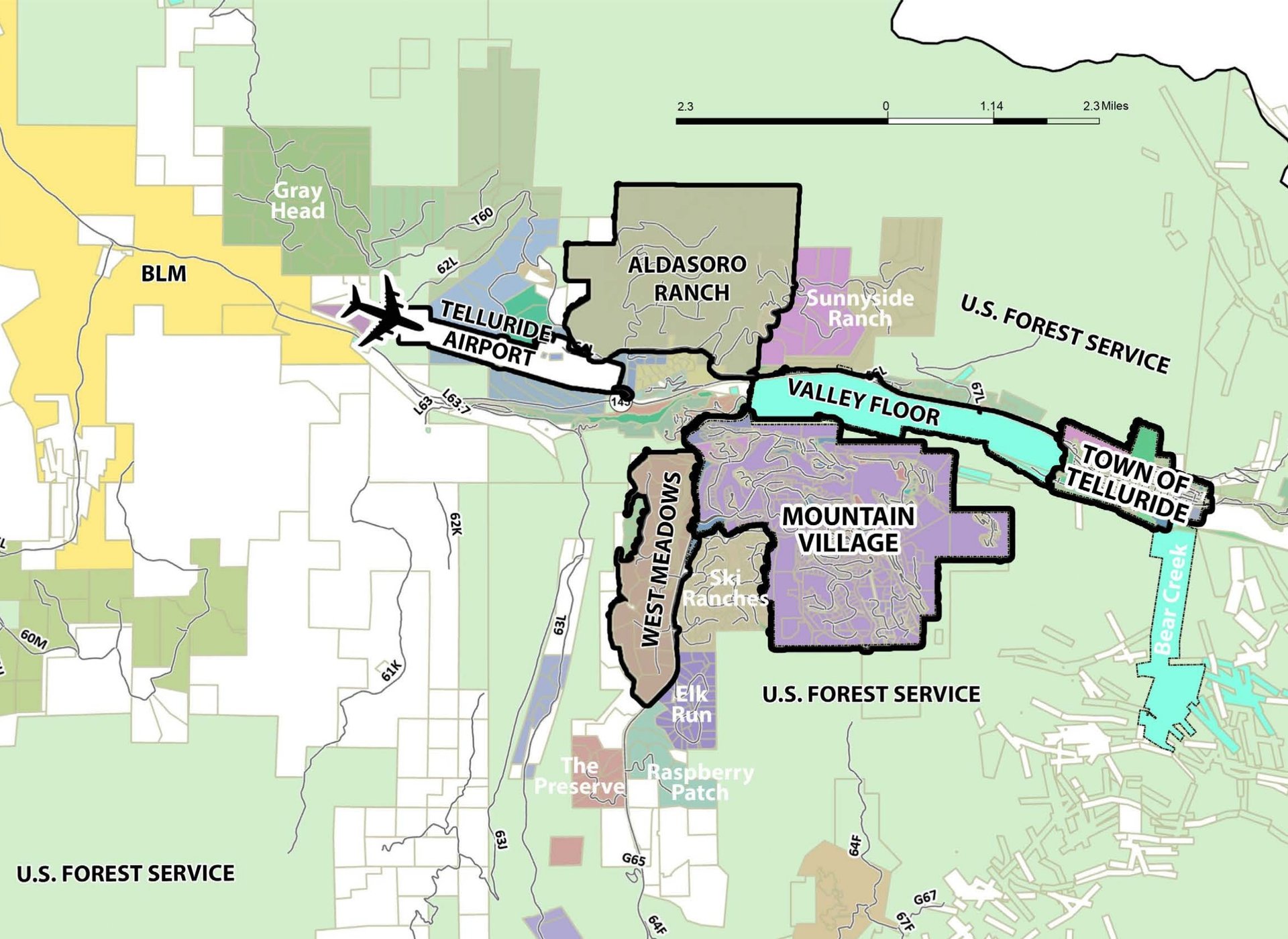
Through the ensuing decades, repeated down-zonings have occurred in places like Aldasoro Ranch, the San Miguel River Valley Floor and West Meadows from thousands of units down to a couple hundred or, in the case of the Valley Floor, fewer. Make no mistake, supply and demand forces are both at full force today.
Telluride and Mountain Village are surrounded by millions of acres of public lands, conservation easements and steep mountains, prohibiting future development and resort sprawl. The scarcity of available land around Telluride, combined with the impact of COVID-19, has driven unprecedented real estate demand. With master-planned PUDs dominating the region, historic absorption rates and entitled projects are limiting new supply and intensifying competition in the market. The Telluride Region is land locked, and we are essentially an island in the mountains.
The entire area is under a master plan with long-established PUDs and restrictions on future growth and expansion. This funnels the buying pool directly into the Telluride and Mountain Village markets. There are some great opportunities in sub-markets immediately adjacent to Mountain Village.
There has been significant down-zoning in our region – areas like:
Demand has outpaced supply, leading to historic absorption rates and over 100% appreciation across nearly every market segment in just a few years. This rapid growth highlights a competitive landscape with limited inventory and rising prices, driving significant value increases. Demand is at an all-time high while inventory is at an all-time low – The Highline a new condo project is 56% contracted (9 of 16 units) at record price per foot having just broken ground in October.
In the Mountain Village Core, there are 4 projects that are fully entitled and represent the last available multi-unit developments in the Mountain Village Core.
Four Seasons Telluride / Six Senses Telluride / The Highline / & Belvedere III
Once these are completed over the next few years, the Mountain Village is out of multi-unit development.
While a little subjective, it would be hard to argue that Telluride is not the most picturesque and most beautiful spot in all of ski country.
Telluride is an “island in the mountains” surrounded by public land, conservation easements and long-established PUDs, all combining to land lock Telluride in a limited growth market.
Through the ensuing decades, repeated down-zonings have occurred in places like ALDASORO RANCH, THE VALLEY FLOOR and WEST MEADOWS from thousands of units down to a couple hundred or 0 in the case of the Valley Floor.
Telluride Regional Airport provides convenient and easy accessibility to the region with both private and domestic flights.
Why People Move to Telluride, Colorado in 2026
Telluride offers something most resort towns cannot: permanence. The town is a National Historic Landmark surrounded by federal land, conservation easements, and established PUDs on all sides, making new residential development essentially impossible. This structural scarcity, combined with 300+ days of sunshine, a world-class ski area with 2,000+ skiable acres, and a year-round festival culture, makes it one of the most compelling relocation markets in the United States. The 2025 market posted $868 million in sales, with median single-family prices at $3,015,000 for 2-3 bedroom homes. Buyers from high-tax coastal markets benefit from Colorado's no-municipal-income-tax environment. Eric Saunders has been involved in over $400 million in Telluride real estate transactions and guides buyers through both the investment case and the lifestyle decision. Start the conversation or view current listings.
Telluride offers one of the most compelling real estate investment cases in the United States because its scarcity is structural, not cyclical. The town is an island in the mountains, surrounded by federal land, conservation easements, and long-established PUDs that collectively make meaningful new development impossible. Supply ceased to increase in the late 1980s. Demand has not stopped growing.
This opportunity is comparable to investing in Aspen, Vail, or Jackson Hole 10-15 years ago. Telluride evolved more slowly and thoughtfully than its peers, resulting in significantly less density and a higher quality of life than resorts now experiencing congestion and overdevelopment.
Telluride and Mountain Village are surrounded by millions of acres of public lands, conservation easements, and steep terrain. The regional master plan has put a hard limit on total density since the late 1980s. Repeated down-zonings have reduced buildable supply from thousands of units to a few hundred across the entire region. The Valley Floor was purchased by the Town of Telluride in 2002 for $50 million specifically to prevent development.
Four entitled projects represent the final major development opportunity in the Mountain Village Core: Four Seasons Telluride, Six Senses Telluride, The Highline, and Belvedere III. These are not speculative -- they are permitted and moving forward. When these are complete, no comparable entitlements remain. Buyers considering new construction inventory should understand that this wave is the last one.
Telluride did not open its ski area until 1972, a full two decades after Aspen and Sun Valley. This lagging timeline allowed it to grow more deliberately, with significantly lower density than its peers. While Aspen and Vail now face congestion and overdevelopment, Telluride is still in the phase of being discovered by the national and international buyer pool. Supply and demand forces are at full force today.
While Telluride is famous for its vertical drop and 2,000+ skiable acres, the real draw for relocation buyers in 2026 is the year-round lifestyle. It is one of the few places in the Rockies where you can attend a world-premiere film festival one day and disappear into the Uncompahgre Wilderness the next.
Telluride's ski area consistently ranks among the least-crowded in Colorado despite its world-class terrain. 300+ inches of average annual snowfall, 2,000+ skiable acres, and direct access from both the historic Town (via gondola) and Mountain Village (ski-in/ski-out) make the winter experience unmatched among comparable Colorado resorts. The relative lack of day-trippers compared to Vail or Breckenridge is a structural advantage of Telluride's geography and distance from Front Range population centers.
The Telluride Bluegrass Festival, Telluride Film Festival, Telluride Jazz Festival, and Telluride Mushroom Festival create a year-round cultural calendar that sustains the town's identity across all four seasons. Hiking, mountain biking, climbing, and trail running provide outdoor activity from May through October. The 300+ days of sunshine make outdoor life during shoulder seasons exceptionally high quality, and the mild summer temperatures (70s during the day, cool evenings) are a significant draw for buyers leaving coastal heat markets.
Snowfall average: Telluride Ski Resort public data. Festival calendar: Telluride events public record. Sunshine days: Colorado Tourism Office.
In Telluride, the available inventory shapes the choice of where to live.
In most markets, you choose a neighborhood and then find a house. In Telluride, supply is so limited that you work with what is available. Eric Saunders knows the current inventory, the off-market opportunities, and which properties will come to market before they are listed. He has been involved in over $400 million in Telluride transactions and guides buyers through both the investment case and the lifestyle fit before they start searching.
Start the ConversationPeople relocate to Telluride primarily for the combination of permanent supply constraint, exceptional natural environment, and a world-class ski area. As a National Historic Landmark surrounded by federal land, Telluride cannot expand or modernize in ways that alter its character. The Victorian townscape, mountain views, and festival culture are structurally protected. Secondary motivations include Colorado's favorable tax environment compared to California or New York, 300+ days of sunshine, the small-town social fabric at a high quality of life standard, and a long-term real estate appreciation thesis driven by permanent scarcity. Telluride is also still early in its discovery curve relative to Aspen and Vail, meaning buyers can still acquire before the market fully matures.
Telluride real estate has historically appreciated strongly due to structural supply constraint. The town is surrounded by federal land, conservation easements, and established PUDs that make meaningful new development impossible. The 2025 market posted $868 million in total sales. Repeated down-zonings since the 1980s have permanently reduced the buildable supply across the region. The four remaining entitled projects in the Mountain Village Core represent the last major development wave. As with any luxury real estate market, individual property performance depends on location, view corridor, ski access, and condition. View market statistics or contact Eric Saunders for a current market analysis.
Telluride is one of the most expensive places to live in Colorado. Median single-family home prices were $3,015,000 for 2-3 bedroom properties in 2025, and $12,200,000 for 5+ bedroom estates. Everyday costs including groceries, dining, and services are higher than the Colorado statewide average due to the remote mountain location and associated logistics. Colorado has no municipal income tax, which partially offsets the high cost of real estate for buyers relocating from high-tax states such as California or New York.
Yes. Telluride's year-round festival calendar, active outdoor culture (hiking, mountain biking, climbing, trail running), and strong local community make it a viable full-time residence, not just a ski town. The Telluride Film Festival, Bluegrass Festival, Jazz Festival, and Mushroom Festival draw visitors and sustain the town's cultural identity across all four seasons. The main practical consideration for full-time residents is access: mountain passes can close in severe winter conditions, and most major retail requires a trip to Montrose, approximately 65 miles away.
Telluride is served by Montrose Regional Airport (MTJ), approximately 65 miles away, with direct flights from Denver (year-round), Dallas, Houston, Los Angeles, and New York (seasonal). Telluride Regional Airport (TEX) on the mesa adjacent to Mountain Village serves private aviation and limited commercial charter service. The drive from Montrose to Telluride takes approximately 90 minutes via Highway 145 through Ridgway and Placerville.
Telluride sits at 8,750 feet elevation, with Mountain Village at approximately 9,545 feet. The town receives over 300 days of sunshine annually. Winters are cold with significant snowfall (the ski area averages over 300 inches annually), but the high-altitude sun makes outdoor activity comfortable on most days. Summer temperatures are typically in the 70s with cool evenings. Buyers from sea level should plan for 2-3 days of acclimatization before strenuous physical activity at altitude.
Eric Saunders has guided clients through over $400 million in Telluride transactions. Start with a private consultation.
Private ConsultationEric loves to help people discover the mountain lifestyle and magic of Telluride. He brings a high level of professionalism and integrity to each transaction; allowing you to relax and enjoy the buying/selling process. He has been involved in over $400 million in real estate transactions and has guided clients through large-scale and single-family developments, condo, commercial and land purchases.