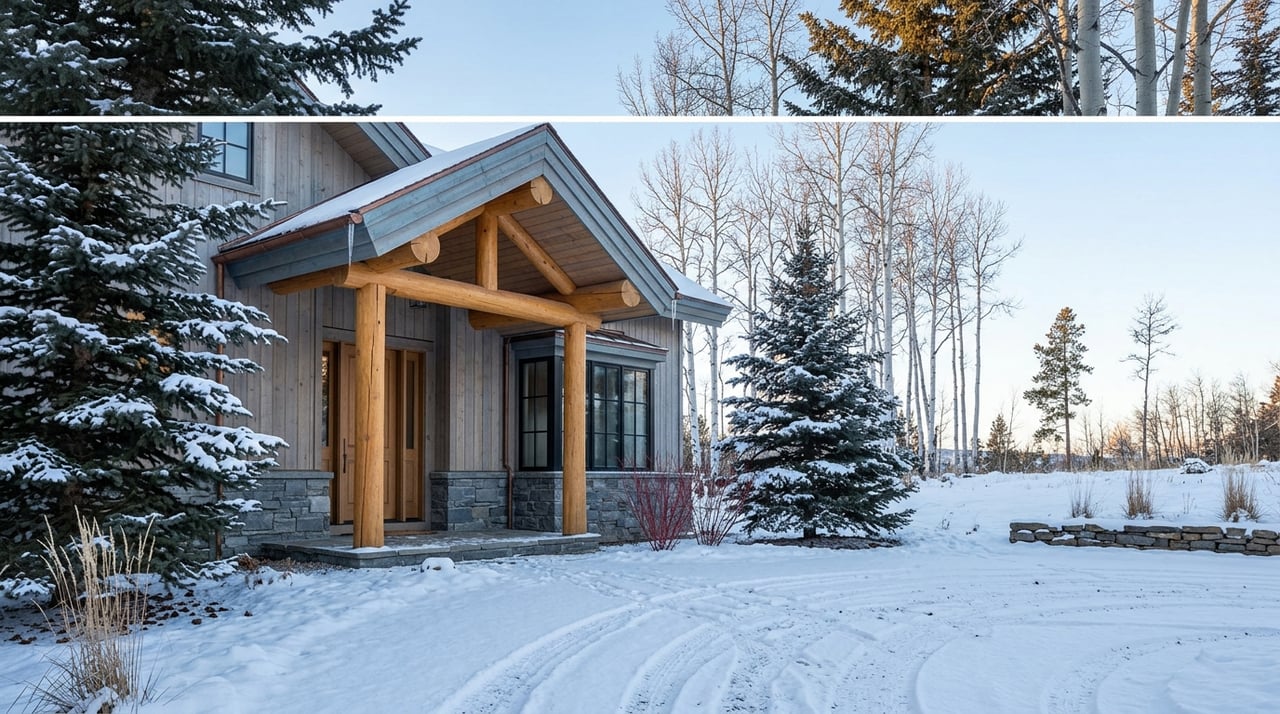
Mountain Village's Gondola Is Free to Ride. It's Not Free to Buy Into.
August 27, 2026
August 27, 2026
Picture a buyer under contract on a $2.4 million residence in Mountain Village. Near the closing table, a line item shows up that nobody put in the marketing brochure: a wire transfer to an entity called TMVOA, for an amount just north of $70,000. A good title company will have flagged it weeks earlier. But the number rarely gets connected, in plain language, to the free gondola the buyer rode a dozen times while touring properties.
That gondola is genuinely free to ride. It is not free to buy into. The distinction matters more than most closing disclosures, and it's about to matter more still, because the funding structure behind it changes at the end of 2027.
The Telluride Mountain Village Owners Association, known locally as TMVOA, is the master owners association for the entire town of Mountain Village. Its largest source of revenue is something called the Real Estate Transfer Assessment, or RETA, assessed at 3% on eligible real estate transactions. That revenue is pledged to the operations and maintenance of the gondola, along with grant funding and event sponsorship for the community.
Run the math on a typical Mountain Village sale and the number stops being abstract fast. A $2.4 million condo carries a $72,000 RETA obligation. A $6 million ski-in ski-out estate carries $180,000. Nothing on the MLS listing tells you that. It shows up in the closing documents, and it shows up because your title company completed a RETA Information Sheet, wired funds directly to TMVOA, and recorded a certification with the San Miguel County Clerk before the deed could clear.
This is not a government transfer tax collected at the county level. It's a private association fee, negotiated by contract when the town was built, and it applies on top of the standard Colorado closing costs that show up in any transaction statewide.
Certain transactions are exempt from RETA, including transfers involving deed-restricted property. If you believe your purchase or sale qualifies, the exemption has to be requested and processed through TMVOA directly, and the association's own materials are explicit about the penalty for missing the window: a transaction that qualifies for exemption but isn't submitted within 30 days of the transfer date triggers a $500 penalty, payable before TMVOA will issue the certificate.
This is the kind of detail that separates a smooth Mountain Village closing from a frustrating one. A title company unfamiliar with TMVOA's process can miss the filing window entirely, and the $500 fee is the smaller cost. The bigger cost is a delayed closing while paperwork gets sorted retroactively. Ask early, and ask a title company that has done this before, not one that's doing it for the first time on your file.
Here's where the story gets more interesting than a line-item fee. TMVOA has stated that it provides approximately $3.5 million annually for gondola operations and maintenance alone, plus historical capital investment including a $6 million system upgrade in 2007 and 2008 and a $1.4 million redundant power system and capacity expansion in 2017.
That accounts for the maintenance side. It doesn't account for everything RETA has generated. Reporting from the Telluride Daily Planet in July 2025 put TMVOA's reserves at $54 million, a figure the association built up as property values climbed sharply during and after the pandemic and RETA revenue outpaced what the gondola actually needed to operate.
A fee designed to fund a specific piece of infrastructure had, by 2025, generated far more than that infrastructure required. What happens to the surplus becomes a governance question, not a maintenance question, and that question got contentious.
In July 2025, TMVOA members voted on amendments to the association's declaration, articles of incorporation, and bylaws, a process required by a 2023 legal settlement to bring the governing documents into compliance with current state law. The amendments changed how voting works within TMVOA, shifted Telluride Ski and Golf Company's ownership sites into a new membership class, and, notably, eliminated annual real estate assessments for the foreseeable future, according to TMVOA's own description of its current functions.
Some members pushed back hard. Concerns raised in Telluride Daily Planet coverage, from members identified as Greenspan and Zoidis, centered on whether Telski's continued board influence, combined with a $54 million reserve and the looming end of the gondola funding obligation, could let the association steer future revenue toward priorities that serve the resort operator more than the town's homeowners. TMVOA Chair Jim Royer pushed back on that characterization in the same reporting, arguing the new governing documents make the association more responsive to homeowners, not less.
Whatever your read on the politics, the practical takeaway for a buyer is this: the annual assessment that used to accompany RETA is currently paused, but the governing structure that decides whether it comes back, and what future RETA revenue funds, changed materially just over a year ago. That's not a static rule you can assume will hold for the life of your ownership.
TMVOA's obligation to fund the gondola runs through the 1999 Gondola Operating Agreement, and that agreement expires December 31, 2027. A Gondola Leadership Committee made up of representatives from the Town of Telluride, Town of Mountain Village, San Miguel County, TMVOA, Telski, and the San Miguel Authority for Regional Transportation, known as SMART, spent roughly five years negotiating what happens after that date.
On November 5, 2024, voters within the SMART taxing district, which shares its boundary with the Telluride R-1 School District, approved Ballot Measure 3A by a 53 to 47 percent margin. The measure raises the sales tax by 0.82%, the lodging tax by 1.25%, and the property tax mill levy by 1.336 mills, an estimated $8.2 million a year in new revenue. Starting in 2028, SMART takes over responsibility for gondola operations and maintenance, funded at roughly $7.2 million annually, more than double what TMVOA currently provides, with the remaining revenue supporting expanded regional bus service and savings toward an eventual gondola replacement estimated at $60 to $100 million.
What that means for RETA specifically is the question this piece keeps circling back to. The 3% assessment was never pledged to the gondola by county or state law. It's TMVOA's own largest revenue stream, committed to the gondola voluntarily because the 1999 agreement obligated the association to fund it. Once that obligation lifts and a regional authority starts funding gondola operations through taxes rather than transfer assessments, RETA doesn't disappear. It becomes revenue without the single purpose that has justified it since Mountain Village was built, collected by an association whose voting structure just changed and whose reserve fund, at $54 million, already exceeds what gondola maintenance ever required. A buyer closing today and planning to hold for a decade will own through that entire transition, and the RETA line on a future closing statement may be funding something the association hasn't fully defined yet.
The Town of Telluride, a separate incorporated municipality just across the gondola line, has no equivalent transfer assessment. Its cost structure runs through different mechanisms entirely, including a short-term rental tax structure that differs meaningfully from Mountain Village's.
| Mountain Village | Town of Telluride | |
|---|---|---|
| Transfer assessment at sale | 3% RETA on eligible transactions | No town-level transfer assessment |
| Short-term rental tax | 9.47% sales tax plus 4% lodging tax, licensed per unit | 17.22% combined monthly tax on licensed non-hotel rentals |
| Governing body | TMVOA (private association) plus Town of Mountain Village | Town of Telluride municipal government |
| Local tax collection platform | MUNIRevs | Rentalscape |
Neither structure is better in the abstract. They're different cost models attached to different lifestyle propositions, and a buyer weighing ski-in ski-out access against walkable historic character needs both numbers, not just the purchase price, to compare what ownership actually costs over time.
Does RETA apply to every sale in Mountain Village? It applies to eligible real estate transactions as defined in TMVOA's governing declaration. Deed-restricted properties are among the recognized exemptions, but exemption status has to be requested and documented through TMVOA's own process, not assumed.
Who pays the 3%, buyer or seller? TMVOA's own materials specify that the buyer and/or seller are responsible for wire transfer fees tied to the payment, but allocation of the underlying 3% assessment itself is a matter for the purchase contract. This is worth negotiating explicitly rather than assuming a default.
Will RETA go away after 2027? There's no indication it will. TMVOA's funding obligation for the gondola ends, and operations shift to SMART, but RETA is TMVOA's largest revenue stream for the association as a whole, not solely the gondola line item. What changes is the governance question of how that revenue gets used once the original justification for it has been fulfilled.
A closing cost that can run into six figures deserves more than a line-item mention two weeks before signing. If you're evaluating a Mountain Village purchase or sale and want a clear read on how RETA, TMVOA's current governance, and the 2028 funding transition actually apply to your specific transaction, Eric Saunders can walk through the numbers with you before you're under contract, not after. Let's Connect.
August 27, 2026
August 20, 2026
Areas
Eric Saunders | August 14, 2026
Areas
Eric Saunders | August 14, 2026

Areas
Eric Saunders | August 14, 2026
Areas
Eric Saunders | August 14, 2026
Local Knowledge & Lifestyle
Eric Saunders | August 14, 2026
Local Knowledge & Lifestyle
Eric Saunders | August 14, 2026
Buying
Eric Saunders | August 14, 2026
Eric loves to help people discover the mountain lifestyle and magic of Telluride. He brings a high level of professionalism and integrity to each transaction; allowing you to relax and enjoy the buying/selling process. He has been involved in over $400 million in real estate transactions and has guided clients through large-scale and single-family developments, condo, commercial and land purchases.